How Much Does It Cost to Run a Dehumidifier? Worked Math
On this page
A dehumidifier typically costs about $0.42 to $2.91 per day to run at the US average residential price of 17.3¢ per kWh. For a mid-size unit running 12 hours a day at 500 watts, the cost is about $31 per month. The calculation is simple: watts divided by 1,000 gives kilowatts, kilowatts times hours gives kWh, and kWh times your rate gives dollars.
Appliance Energy Cost CalculatorCost per hour, day, month and year for anything you plug in.Worked math at the US average rate
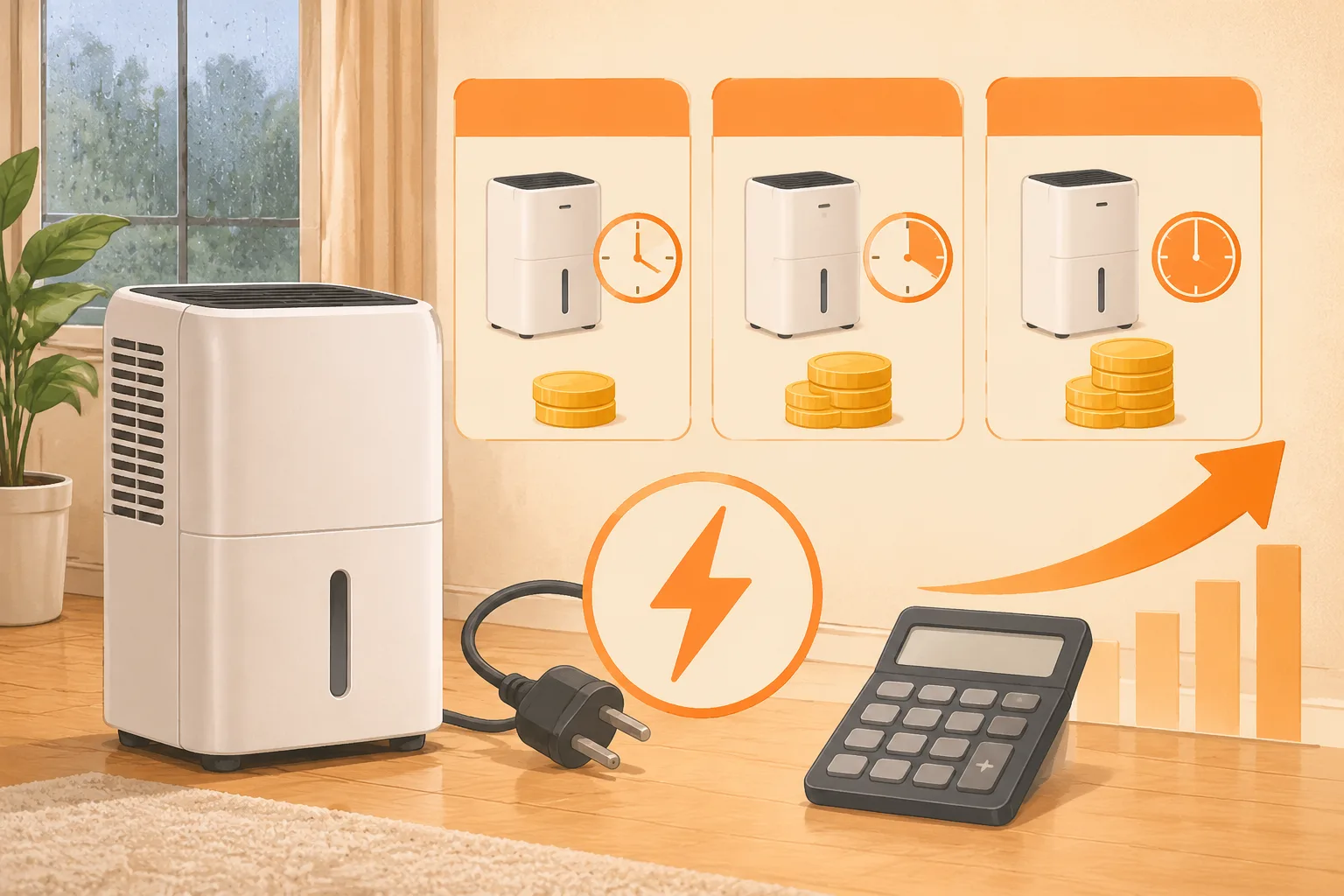
Dehumidifier wattage is not standardized, so check the label on your unit or its spec sheet. The three scenarios below use illustrative wattages, not specifications for any particular model. The rate is 17.3¢ per kWh from the EIA Electric Power Monthly, Table 5.6.A (November 2025, preliminary). Monthly figures assume 30 days.
| Scenario | Wattage | Hours per day | kWh per day | kWh per month | Cost per day | Cost per month |
|---|---|---|---|---|---|---|
| Light use | 300 W | 8 | 2.4 | 72 | $0.42 | $12.46 |
| Moderate use | 500 W | 12 | 6.0 | 180 | $1.04 | $31.14 |
| Continuous | 700 W | 24 | 16.8 | 504 | $2.91 | $87.19 |
Here is the moderate row in full. 500 W is 0.5 kW. Running 12 hours uses 0.5 × 12 = 6.0 kWh per day. Over 30 days that is 6.0 × 30 = 180 kWh. At 17.3¢, the monthly cost is 180 × 0.173 = $31.14, and the daily cost is 6.0 × 0.173 = $1.04.
The continuous row follows the same steps. 0.7 kW × 24 hours = 16.8 kWh per day, 16.8 × 30 = 504 kWh per month, and 504 × 0.173 = $87.19.
Over a full year, the moderate scenario uses 180 × 12 = 2,160 kWh, which costs 2,160 × 0.173 = $373.68. For comparison, 180 kWh is about 21 percent of the 863 kWh that the EIA lists as typical US residential use per month (180 ÷ 863 ≈ 0.21).
How your rate changes the answer
Your state rate can change the monthly cost more than the choice of unit does. The table below uses the same moderate scenario of 180 kWh per month.
| Location | Rate per kWh | Cost for 180 kWh per month |
|---|---|---|
| North Dakota (lowest in EIA data) | 11.93¢ | 180 × 0.1193 = $21.47 |
| US average | 17.3¢ | 180 × 0.173 = $31.14 |
| California | 31.91¢ | 180 × 0.3191 = $57.44 |
| Hawaii (highest in EIA data) | 40.2¢ | 180 × 0.402 = $72.36 |
The same dehumidifier costs about 3.4 times as much to run in Hawaii as in North Dakota ($72.36 ÷ $21.47 ≈ 3.37). To find your own rate, check the state rates table or the rate printed on your bill.
What controls runtime
Most portable dehumidifiers use a humidistat, a built-in humidity sensor that turns the compressor off once the room reaches the set point. Runtime therefore depends on three things: how much moisture enters the room, how humid the outdoor air is, and the set point you choose. A basement with a damp floor and a dryer vent indoors will keep the unit running far longer than a dry bedroom.
Runtime has a larger effect on cost than most people expect. The 500 W unit above costs $31.14 per month at 12 hours a day. At 6 hours a day, it costs 500 × 6 × 30 = 90 kWh, or 90 × 0.173 = $15.57 per month. Halving the runtime halves the bill.
Ways to lower the cost
The most effective step is to reduce the moisture the unit has to remove. Venting the clothes dryer to the outside, running bathroom exhaust fans during and after showers, and sealing obvious water entry points in a basement all lower the load. Those changes reduce the hours the dehumidifier runs.
Set the humidistat to the lowest comfortable level rather than the lowest possible setting. A setting around 50 percent relative humidity is a common target for most homes, though the right number depends on the room and on any mold or allergy concerns you have. Keep the filter clean so airflow stays strong, and empty the bucket or use a continuous drain hose so the unit does not shut off because the tank is full.
To measure your own unit, plug it into a plug-in power meter for a day or a week. Multiply the average kWh per day by 30 and then by your rate. Measured numbers beat estimates from a label, because the real draw changes with temperature and humidity. The Appliance Energy Cost Calculator runs the same math for any wattage and hours you enter, and the guide to the biggest electricity users in a house shows where a dehumidifier ranks against other appliances.
Safety notes
Plug the dehumidifier directly into a wall outlet. Extension cords and power strips are not designed for the sustained load of a compressor, and they can overheat. If the outlet or plug feels warm, or the breaker trips when the unit starts, stop using that outlet and have a licensed electrician check the circuit. Keep the unit level and leave clear space around the air intake and outlet so it can move air freely.
Frequently asked questions
Is a dehumidifier expensive to run?
It depends on wattage and hours. A 500 W unit running 12 hours a day costs about $31 per month at the US average rate of 17.3¢ per kWh. Cutting runtime with a humidistat and reducing moisture sources usually lowers that number the most.
How much does a dehumidifier add to a monthly electric bill?
For the moderate scenario, the unit adds about 180 kWh per month. That is roughly 21 percent of the typical US home's 863 kWh, and the dollar amount ranges from about $21 in North Dakota to about $72 in Hawaii at the rates in this article.
Does running it continuously cost a lot?
A 700 W unit running 24 hours a day costs about $87 per month at 17.3¢ per kWh. Continuous operation is rarely needed in a well-ventilated home, so check whether the humidistat cycles the unit off as it should.
Is it safe to use an extension cord?
Avoid it. Dehumidifiers draw steady power for long periods, and extension cords and power strips can overheat under that load. Plug the unit into a wall outlet, and have an electrician inspect any outlet that gets warm.