Cost to Charge an Electric Car at Home Per Month: Worked Math
On this page
Charging an electric car at home usually costs about $58 a month for a driver who covers 1,000 miles, using the US average residential rate of 17.3¢ per kWh. That estimate assumes the car uses about 0.30 kWh per mile. Your real cost depends on how far you drive, how efficient your vehicle is, and what your utility charges.
Electric Bill CalculatorEstimate your monthly bill from kWh and your state's rate.The formula and a worked example
Monthly charging cost = miles driven × kWh per mile ÷ charging efficiency × rate per kWh.
Using the assumptions above:
- Energy stored in the battery: 1,000 miles × 0.30 kWh/mile = 300 kWh.
- Energy drawn from the outlet: charging loses roughly 10% as heat, so 300 ÷ 0.90 = 333.33 kWh.
- Monthly cost: 333.33 kWh × $0.173 = $57.67.
The cost per mile works out to 0.30 × $0.173 ÷ 0.90 ≈ $0.058, or about 5.8¢ per mile.
The 0.30 kWh/mile figure is a rough rule of thumb. Most electric cars fall somewhere between about 0.25 and 0.35 kWh per mile. Check the efficiency rating in your vehicle's specifications and plug in your own number. Each additional 0.05 kWh per mile adds about $9.61 a month at 1,000 miles: 1,000 × 0.05 ÷ 0.90 × $0.173 = $9.61.
How your state changes the bill
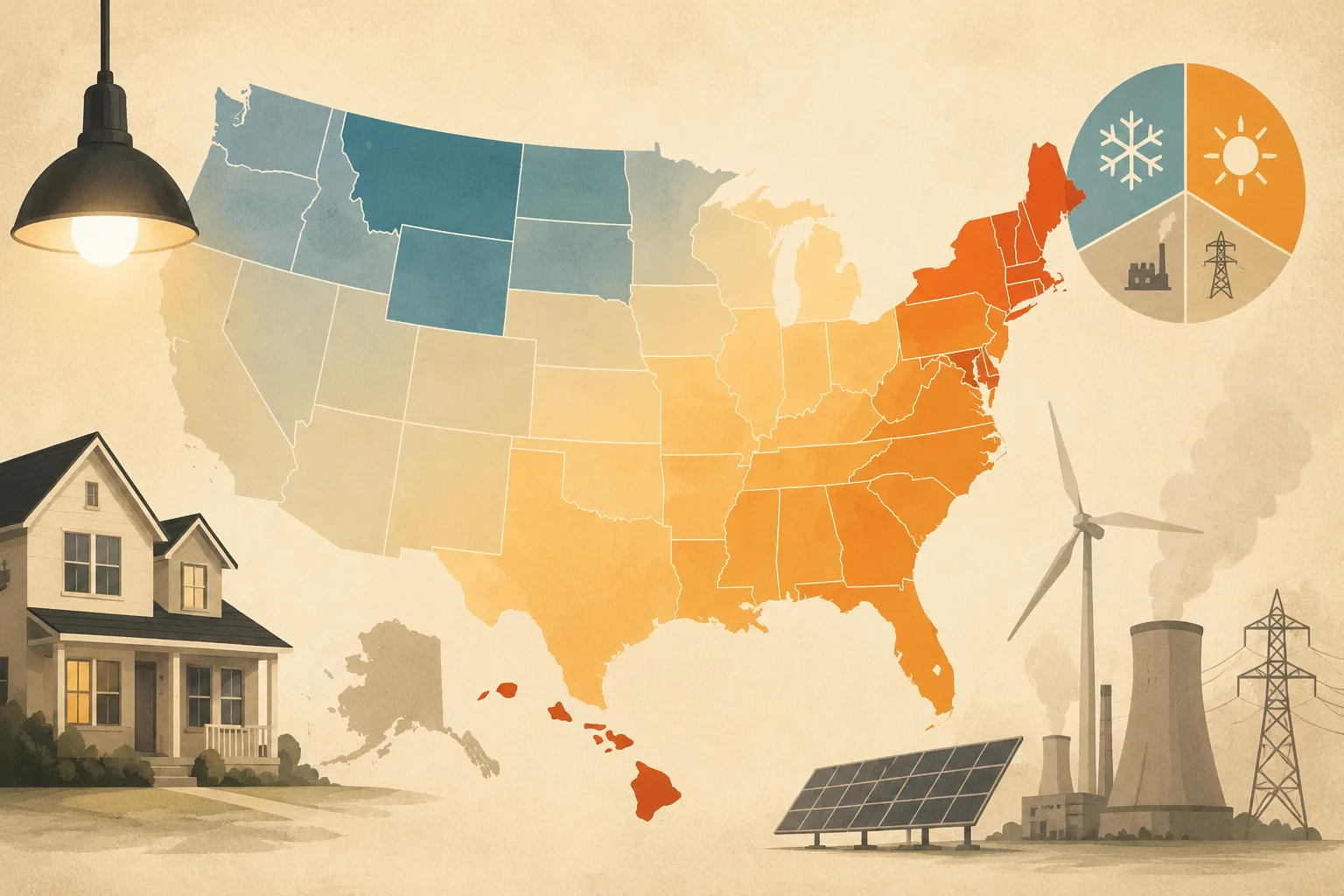
The rate you pay matters as much as the miles you drive. The table below uses EIA's November 2025 preliminary residential prices (Table 5.6.A). Those figures are state averages, so your utility's rate may be higher or lower. The electricity rates by state page lists the rates for each state.
| Location | Rate per kWh | 500 miles/month | 1,000 miles/month | 1,500 miles/month |
|---|---|---|---|---|
| North Dakota (lowest) | 11.93¢ | $19.88 | $39.78 | $59.65 |
| US average | 17.3¢ | $28.83 | $57.67 | $86.50 |
| California | 31.91¢ | $53.19 | $106.37 | $159.55 |
| Hawaii (highest) | 40.2¢ | $67.00 | $134.00 | $201.00 |
The outlet energy for each mileage is 500 miles = 166.67 kWh, 1,000 miles = 333.33 kWh, and 1,500 miles = 500 kWh. Multiply that energy by the rate to get each cost. For example, Hawaii at 500 miles is 166.67 × $0.402 = $67.00.
A driver in Hawaii pays roughly five times what a driver in North Dakota pays for the same miles at these rates: $134.00 against $39.78 at 1,000 miles.
Charger speed changes charging time, not the bill
A standard 120-volt outlet, often called Level 1, delivers about 1.44 kW when it runs a 12-amp load (120 V × 12 A). A dedicated 240-volt Level 2 circuit works faster. A 40-amp breaker is commonly loaded to 80% for continuous use under the National Electrical Code, which leaves 32 amps. At 240 volts, that gives 32 A × 240 V = 7.68 kW.
The monthly charging hours follow from the energy needed:
- Level 1: 333.33 kWh ÷ 1.44 kW ≈ 231 hours a month, or about 7.7 hours a day.
- Level 2: 333.33 kWh ÷ 7.68 kW ≈ 43 hours a month, or about 1.5 hours a day.
Both options cost the same per kWh. The charger changes how long the car plugs in, not the monthly total.
Off-peak rates can lower the bill
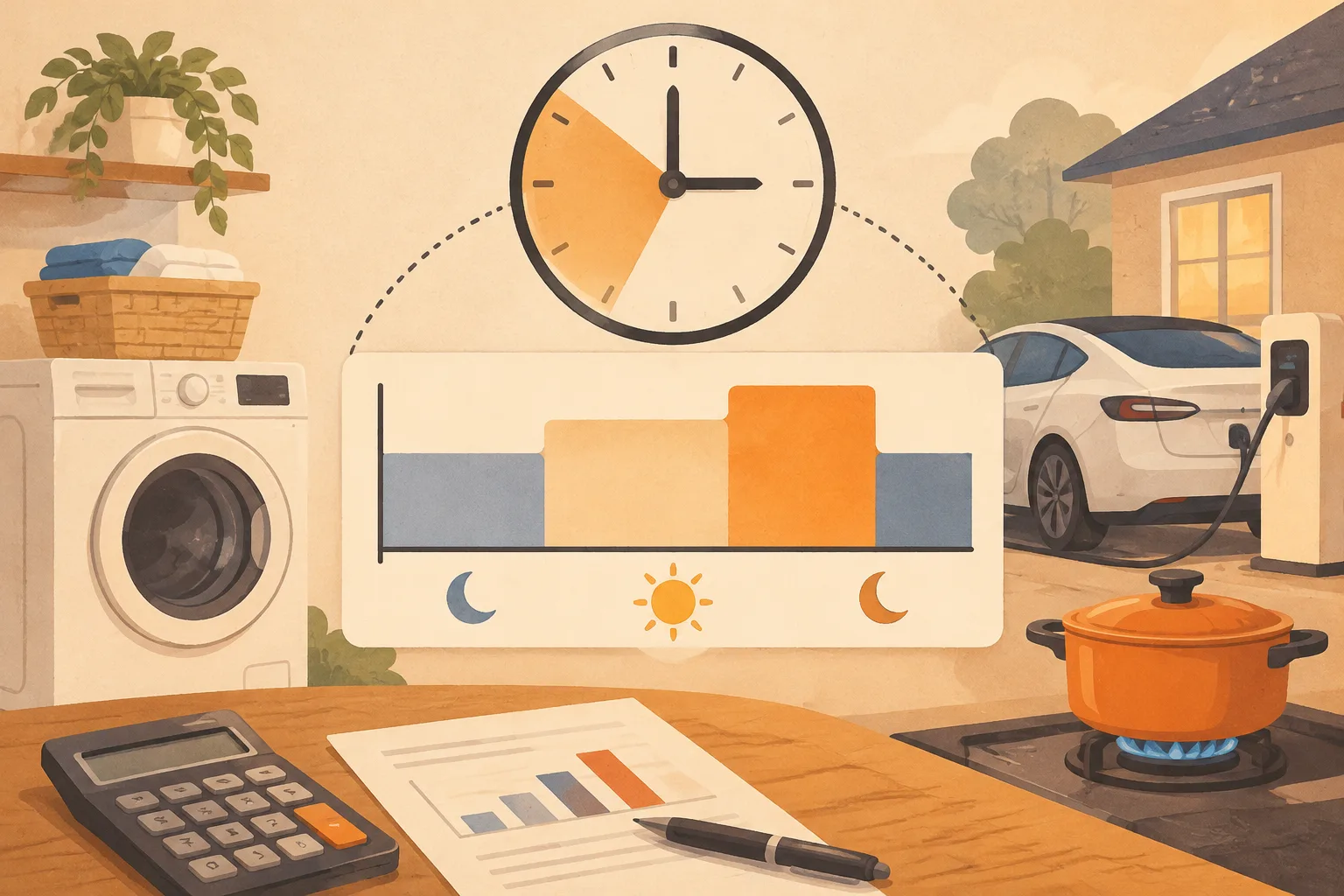
Many utilities offer time-of-use plans with lower overnight rates. Overnight charging can cut the bill sharply if the off-peak rate is much lower than your standard rate. As an illustration only, with a hypothetical overnight rate of 10¢ per kWh, 333.33 kWh costs 333.33 × $0.10 = $33.33 a month. Your utility will publish its real off-peak rate and hours. The time-of-use plan worked example shows how to check whether a plan saves money for your usage.
Home electrical safety
A Level 2 charger needs a dedicated circuit that a licensed electrician sizes and installs for the charger's load. Do not charge every day from a standard extension cord or power strip, and do not use an outlet that feels warm or shows scorching. If an outlet or cord gets hot during charging, stop using it and have an electrician inspect the circuit.
Frequently asked questions
Does a Level 2 charger make charging cost more?
No. The bill depends on the kWh the car uses and the rate you pay per kWh. A Level 2 charger finishes the same charge in fewer hours, which means it does not add energy to the total. Charging speed affects scheduling, not the monthly cost.
How much does home charging add to a typical house's electricity use?
EIA's typical US home uses 863 kWh per month. At 333.33 kWh a month for 1,000 miles, the car adds about 333.33 ÷ 863 ≈ 39% to that total. Your bill rises by a similar share, before any change in your rate plan.
What if my car uses more than 0.30 kWh per mile?
Use your vehicle's rated efficiency in the formula above. Cost scales in a straight line with kWh per mile, so a car that uses 0.35 kWh per mile costs about $67.27 a month at 1,000 miles and the US average rate: 1,000 × 0.35 ÷ 0.90 × $0.173 = $67.28, rounded to the cent based on the exact math shown.
Where can I find my actual rate?
Your electric bill shows your price per kWh and any fixed or delivery charges. The electric bill calculator estimates a monthly bill from your kWh and rate. To compare the cost of charging with the rest of your house, the appliance energy cost calculator converts any device's wattage into a monthly cost.