What Uses the Most Electricity in a House (Ranked With Numbers)
On this page
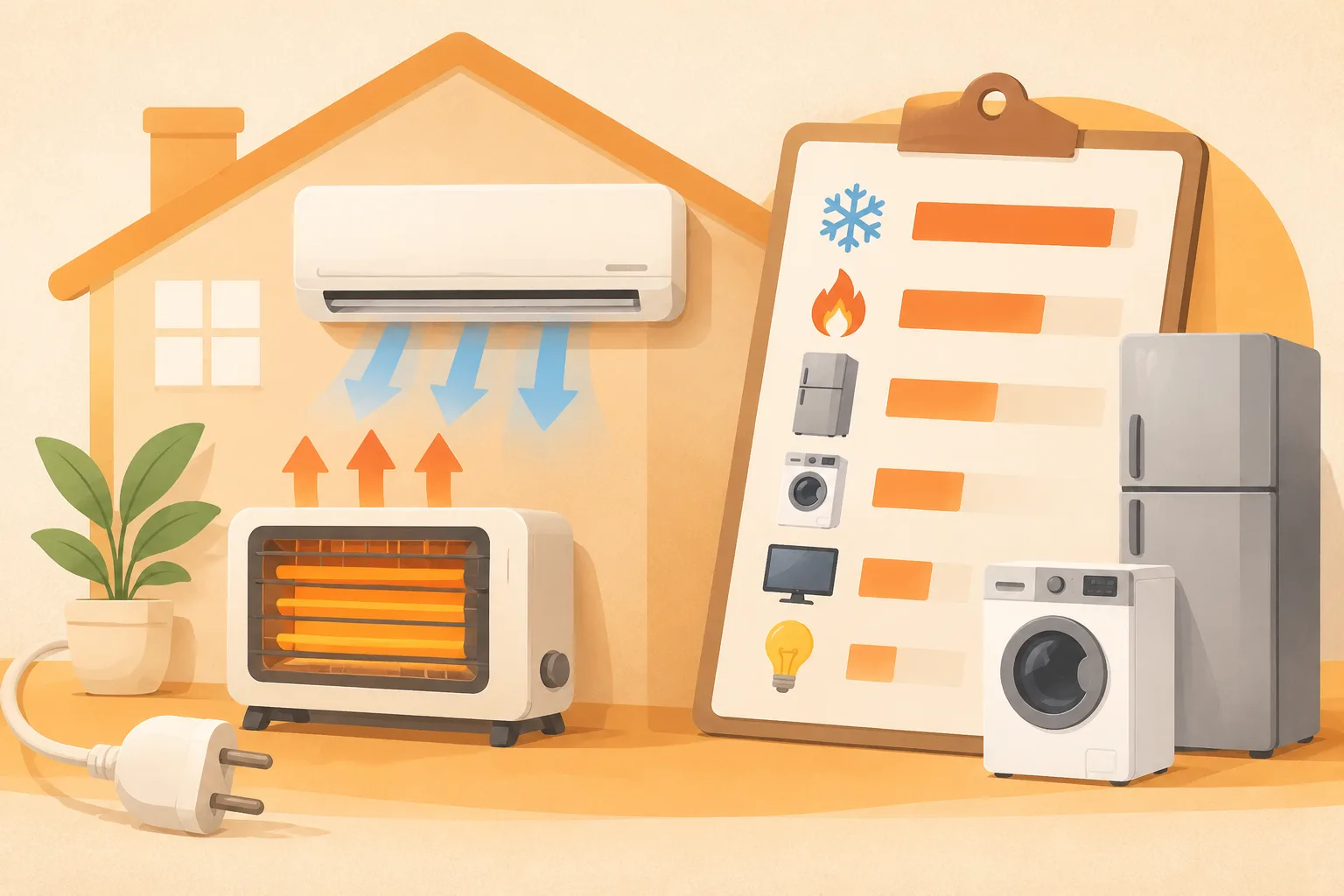
Heating and cooling use the most electricity in most US homes. In the scenarios below, central air conditioning and electric water heating each cost more per month than a refrigerator, a TV, and all of the lighting combined.
The list ranks common appliances by monthly kWh and dollar cost at the US average residential rate of 17.3¢ per kWh.
Appliance Energy Cost CalculatorCost per hour, day, month and year for anything you plug in.How the ranking is calculated
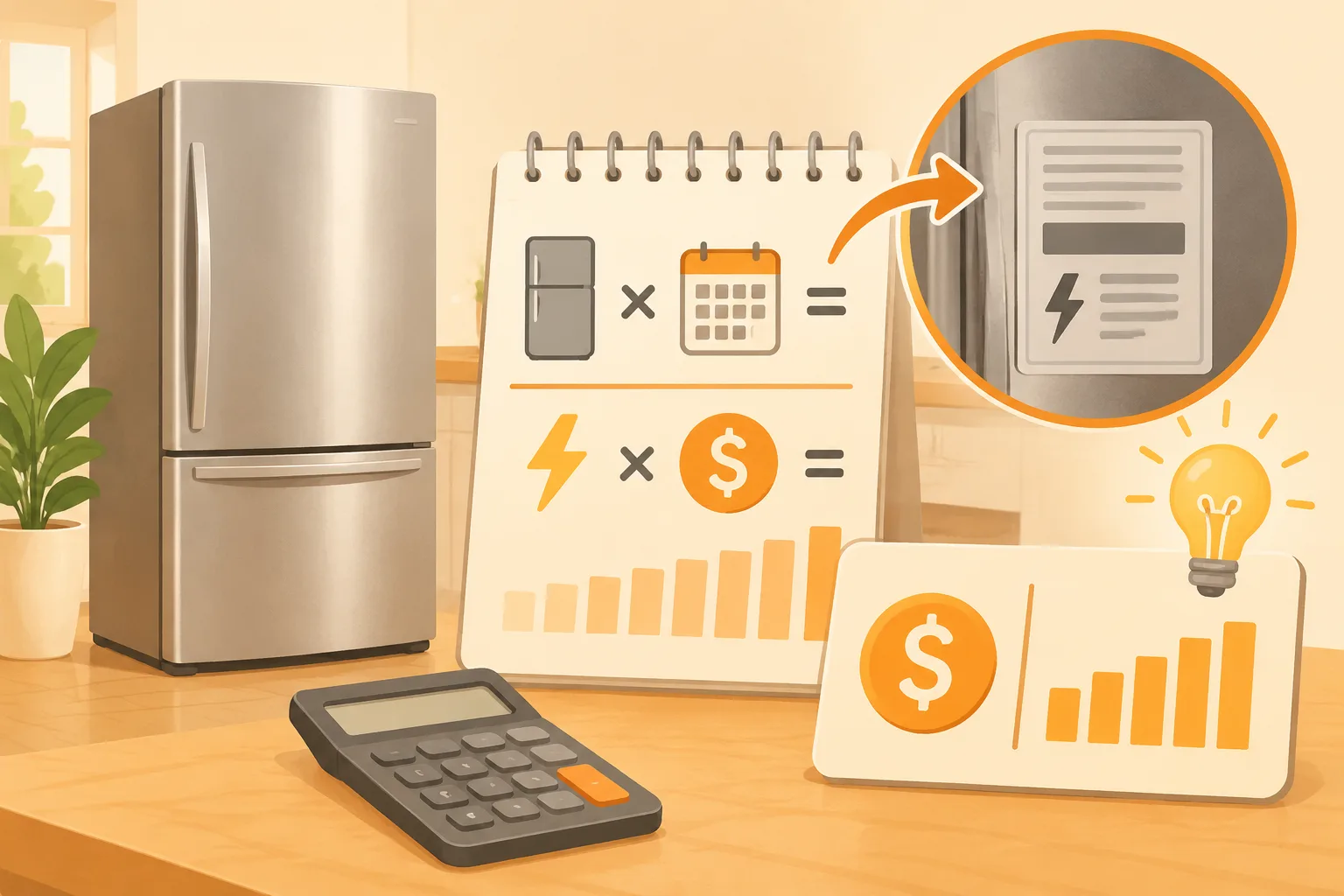
Every estimate uses the same two formulas:
kWh per month = watts × hours per day × days per month ÷ 1,000
Monthly cost = kWh per month × rate per kWh
The rate comes from the US average residential price in EIA's Electric Power Monthly, Table 5.6.A (November 2025, preliminary). The wattages and run times are planning assumptions for a typical household, not measurements of any one unit. Check the label on your own appliance, then enter your numbers into the Appliance Energy Cost Calculator.
The ranked list
| Rank | Appliance | Assumed use | kWh per month | Cost per month at 17.3¢ |
|---|---|---|---|---|
| 1 | Central air conditioning | 3,500 W, 6 hours/day, 30 days | 630 | $109.00 |
| 2 | Electric water heater | 4,500 W, 2.5 effective hours/day, 30 days | 337.5 | $58.39 |
| 3 | Electric range (one element) | 2,400 W, 1 hour/day, 30 days | 72 | $12.46 |
| 4 | Electric clothes dryer | 5,000 W, 0.75 hours per load, 12 loads | 45 | $7.79 |
| 5 | Refrigerator | 150 W, 40% duty cycle, 24 hours/day | 43.2 | $7.47 |
| 6 | Dishwasher | 1,800 W, 0.5 hours per load, 20 loads | 18 | $3.11 |
| 7 | Television | 100 W, 5 hours/day, 30 days | 15 | $2.60 |
| 8 | LED lighting | 10 bulbs at 9 W, 5 hours/day | 13.5 | $2.34 |
| 9 | Washing machine | 500 W, 1 hour per load, 20 loads | 10 | $1.73 |
Each row is a separate scenario. The nine rows together would total about 1,184 kWh, which is more than the 863 kWh that EIA lists as a typical US monthly use. The ranking shows relative size, which is the useful part when you decide where to cut.
Heating and cooling: the two largest loads
Central air conditioning at 630 kWh is about 73% of the 863 kWh typical month (630 ÷ 863 = 0.73). At 17.3¢, that runtime costs $109.00 per month. The same load costs $75.16 at North Dakota's 11.93¢ rate (630 × 0.1193) and $175.46 at Maine's 27.85¢ rate (630 × 0.2785). For a closer look at how runtime and thermostat settings change the total, read How Much Does It Cost to Run Central Air Conditioning Per Month?
Electric space heating follows the same math. A 1,500 W space heater run 4 hours a day for 30 days uses 180 kWh (1,500 × 4 × 30 ÷ 1,000), or $31.14 per month.
Safety note: plug a space heater directly into a wall outlet. Do not use an extension cord or power strip, because a high continuous load can overheat them. Keep the heater at least 3 feet from curtains, bedding, and other combustible items.
Water heating and cooking
An electric water heater with 2.5 effective element hours per day uses 337.5 kWh per month (4,500 × 2.5 × 30 ÷ 1,000). That is 39% of the typical 863 kWh month (337.5 ÷ 863 = 0.39), and it costs $58.39 at the average rate. Water heating is the second-largest load in this ranking, and it depends on how much hot water the household uses and how hot the tank is set.
Cooking is much smaller. A 2,400 W electric range element run one hour a day for 30 days uses 72 kWh, or $12.46 per month. Most households bake or simmer only occasionally, so the monthly total shifts with cooking habits.
Laundry, refrigeration, and electronics
The electric clothes dryer uses 45 kWh per month in this scenario (5,000 W × 0.75 hours × 12 loads ÷ 1,000), or $7.79. Its wattage is high, but the short run time per load keeps the monthly total modest. A gas dryer moves this load to natural gas or propane, which has its own price.
The refrigerator runs around the clock, so its share stays steady. With a 40% duty cycle, an average draw of 60 W over 24 hours gives 43.2 kWh per month, or $7.47. It ranks fifth, below the range and the dryer, mainly because its wattage is low. Keeping the coils clean and the door seal intact helps it run efficiently.
Electronics and lighting are small individually. A 100 W television watched 5 hours a day uses 15 kWh ($2.60). Ten 9 W LED bulbs used 5 hours a day use 13.5 kWh ($2.34). Add the washer at 10 kWh ($1.73), and these smaller loads together still matter less than cooling or water heating.
State rates change the bill more than most habits
The same usage costs very different amounts depending on where the home is located. This table applies the lowest, average, and highest rates from the EIA data to the two largest loads.
| Rate case | Price per kWh | Central AC (630 kWh/month) | Electric water heater (337.5 kWh/month) |
|---|---|---|---|
| North Dakota (lowest) | 11.93¢ | $75.16 | $40.26 |
| US average | 17.3¢ | $109.00 | $58.39 |
| Maine | 27.85¢ | $175.46 | $93.99 |
| Hawaii (highest) | 40.2¢ | $253.26 | $135.68 |
Hawaii's 40.2¢ rate is 2.3 times the US average, so the same air conditioning runtime costs more than twice as much there. Maine's rate is about 61% above the average. To find your state's rate, check the electricity rates by state page. Then run your own usage through the Electric Bill Calculator. Utility rates change over time, so treat these figures as a snapshot from EIA's November 2025 preliminary data.
Frequently asked questions
Is my refrigerator one of the biggest electricity users?
No. In this scenario, it uses 43.2 kWh per month, about 5% of the 863 kWh typical month. It runs all the time, so its cost stays fairly constant, while heating and cooling change with the weather. Check the energy label or the manufacturer's specifications for a figure that matches your model.
Why doesn't my bill match these estimates?
Your bill depends on climate, home size, insulation, thermostat settings, and how many hours each device actually runs. Use the kWh total printed on your bill, not a rough guess, in the Electric Bill Calculator. Comparing your total with the 863 kWh national typical month shows whether your usage is high or low.
What lowers the biggest loads fastest?
Start with the thermostat. Raising the cooling setpoint or lowering the heating setpoint while the house is empty reduces runtime on the largest load. Lowering the water heater to a comfortable temperature and using less hot water reduces the second-largest one. Compare your bill before and after making changes to confirm how much each one saved.