How Much Electricity Does a Refrigerator Use Per Month? kWh and Cost
On this page
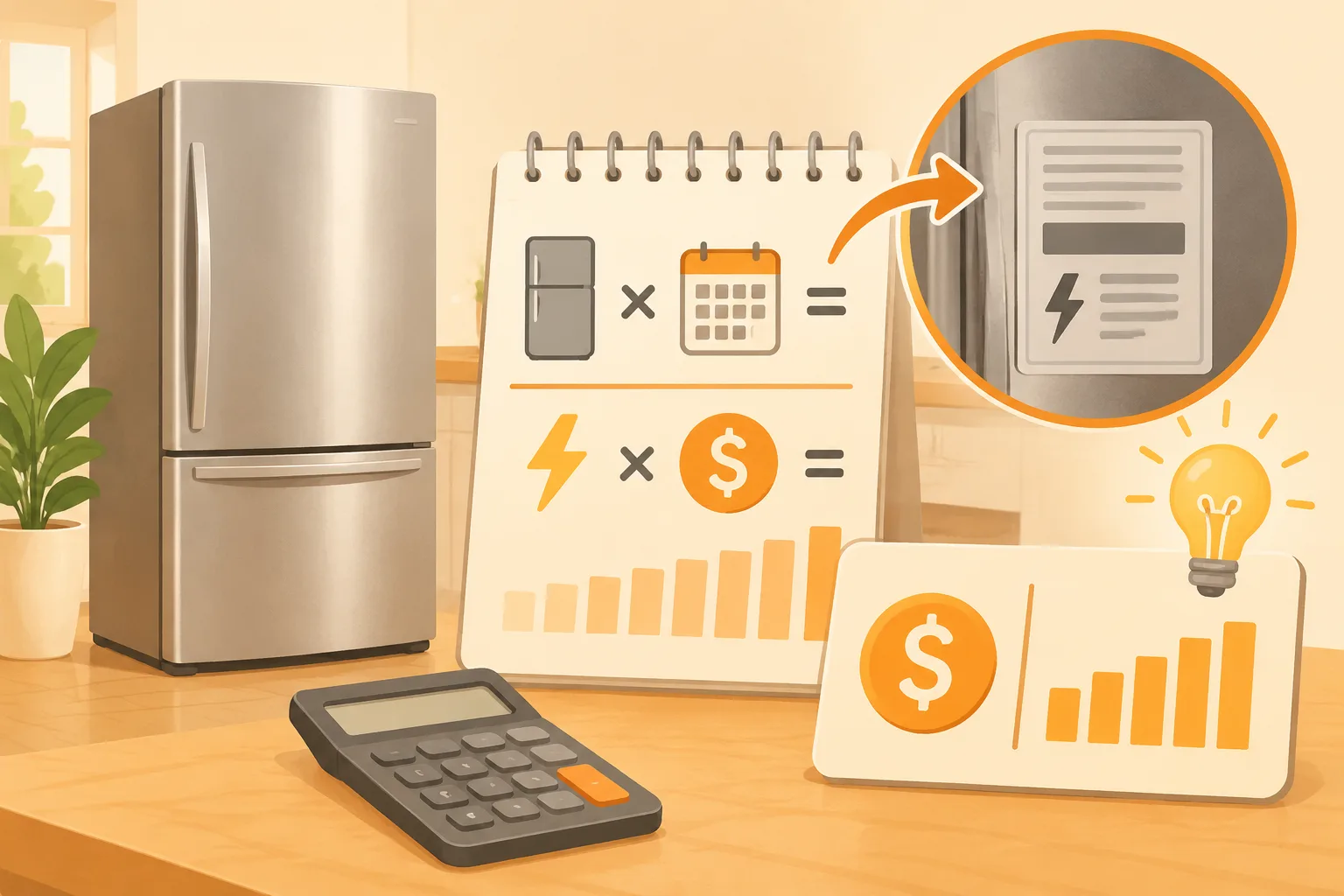
A refrigerator's monthly electricity use is its annual kWh rating divided by 12. Multiply that by your electricity rate in dollars per kWh to get the monthly cost. At the US average residential price of 17.3 cents per kWh, a fridge rated at 500 kWh per year uses about 41.7 kWh a month and costs about $7.21.
Appliance Energy Cost CalculatorCost per hour, day, month and year for anything you plug in.Why the answer depends on the fridge
A fridge does not run at full power all day. Its compressor switches on and off, and the share of time it runs is called the duty cycle. Monthly energy use is average power multiplied by hours:
kWh per month = average watts x 24 hours x days / 1,000
As a worked example, assume a running draw of 150 W and a duty cycle of 40%. This 150 W figure is an illustrative value, not a measured spec for any model.
- Average power: 150 W x 0.40 = 60 W
- Daily energy: 60 W x 24 h = 1,440 Wh = 1.44 kWh
- Monthly energy: 1.44 kWh x 30 days = 43.2 kWh
- Monthly cost at 17.3 cents: 43.2 x $0.173 = $7.47
The same fridge uses about 518 kWh over a year (43.2 x 12), which sits between the 500 and 700 kWh rows in the table below.
Use the label on your fridge
US refrigerators sold with an EnergyGuide label list an estimated yearly energy use in kWh. That figure is the most reliable input because it reflects the specific model. Check the label on the side or back of the unit, or the manufacturer's spec sheet, and use the kWh per year number.
Follow three steps:
- Find the estimated kWh per year on the label.
- Divide that number by 12 to get kWh per month.
- Multiply by your rate. Use the price per kWh from your bill, not the total bill. The electric bill calculator helps if your bill is hard to read.
If your bill lists delivery and fixed charges, the per-kWh energy rate is usually a separate line. Those other charges do not change with the fridge's use, so leave them out of this calculation.
Monthly cost at three annual ratings
The table below uses the US average rate of 17.3 cents per kWh. It also shows each rating as a share of the 863 kWh that a typical US home uses in a month, based on EIA data for November 2025 (preliminary).
| Annual rating (kWh/yr) | kWh per month | Monthly cost at 17.3 cents | Share of 863 kWh typical month |
|---|---|---|---|
| 350 | 29.2 | $5.05 | 3.4% |
| 500 | 41.7 | $7.21 | 4.8% |
| 700 | 58.3 | $10.09 | 6.8% |
Calculations: 350 / 12 = 29.17 kWh, and 29.17 x $0.173 = $5.05. For 500 kWh per year, 41.67 x $0.173 = $7.21. For 700 kWh per year, 58.33 x $0.173 = $10.09. The share column divides each monthly figure by 863.
How your state changes the cost
The same fridge costs very different amounts depending on where you live. Using the 500 kWh per year rating (41.7 kWh per month), these EIA November 2025 preliminary rates produce these monthly costs:
- North Dakota, 11.93 cents: 41.67 x $0.1193 = $4.97
- Louisiana, 12.74 cents: 41.67 x $0.1274 = $5.31
- Maine, 27.85 cents: 41.67 x $0.2785 = $11.60
- California, 31.91 cents: 41.67 x $0.3191 = $13.30
- Hawaii, 40.2 cents: 41.67 x $0.402 = $16.75
The fridge's kWh does not change, so the gap comes entirely from rates. For the full list, see the electricity rates by state table.
Running a fridge during an outage
A fridge is one of the largest continuous loads in a home that a portable power station might carry. Using the same 1.44 kWh per day from the worked example, a battery system must supply more energy than the fridge uses because of losses. The LiFePO4 battery is assumed to deliver 95% of its rated energy, and the inverter is assumed to run at 88% efficiency.
- Battery energy for the fridge alone: 1.44 / (0.95 x 0.88) = 1.44 / 0.836 = about 1.72 kWh per day
- Adding the inverter's 12 W idle draw over 24 hours (0.288 kWh): (1.44 + 0.288) / 0.836 = about 2.07 kWh per day
Use the power station runtime calculator with your own battery capacity and fridge rating. To size a whole backup plan, the backup power size calculator gives the watts and watt-hours you need.
Safety matters more than the math here. Never run a gasoline or propane generator inside a home, garage, or shed, and keep it well away from doors and windows. Carbon monoxide can build up quickly. A closed fridge and freezer keep food cold for about four hours during a power outage, according to USDA and FDA food safety guidance, so keep the doors shut.
Ways to lower the fridge's share of your bill
Several habits reduce how hard the compressor works. Set the fridge to 40 F or below and the freezer to 0 F, which are the temperatures the FDA recommends. Clean the condenser coils once or twice a year so heat can leave the unit. Check door gaskets by closing the door on a dollar bill: if it slides out easily, the seal needs attention. Keep the fridge out of direct sun and away from the oven.
A second fridge, often in a garage, runs all year and can add a large share to the bill. Compare its label rating with the figures above before deciding whether to keep it. For context on where the rest of a home's electricity goes, see how much electricity a house uses per day.
Frequently asked questions
Does a refrigerator use more electricity in summer?
Yes, usually. A hotter kitchen or garage makes the compressor run for a larger share of the time to remove the same heat. That raises the duty cycle, so the monthly kWh goes up. The label rating is measured under standard test conditions, so real summer use can exceed it.
Is an older refrigerator much more expensive to run?
Older models often use more energy than newer ones, and the gap can be large. Compare the kWh per year on each label. For example, if an old fridge rates 700 kWh per year and a newer one rates 500 kWh per year, the difference is 200 kWh x $0.173 = $34.60 per year at the US average rate.
Does a fuller refrigerator use less electricity?
A reasonably full fridge holds its temperature better when the door opens, because cold items absorb some of the heat that enters. An empty fridge loses cold air faster and makes the compressor work harder to recover. Good airflow still matters, so do not pack items so tightly that vents are blocked.
Should I unplug a second refrigerator in the garage?
It depends on whether you need the extra storage. Look up its kWh per year on the label, divide by 12, and multiply by your rate to see the monthly cost. If you only use it for occasional storage, a smaller unit or unplugging it between uses can lower the bill.