Electric Blanket vs Space Heater: Which Is Cheaper to Run?
On this page
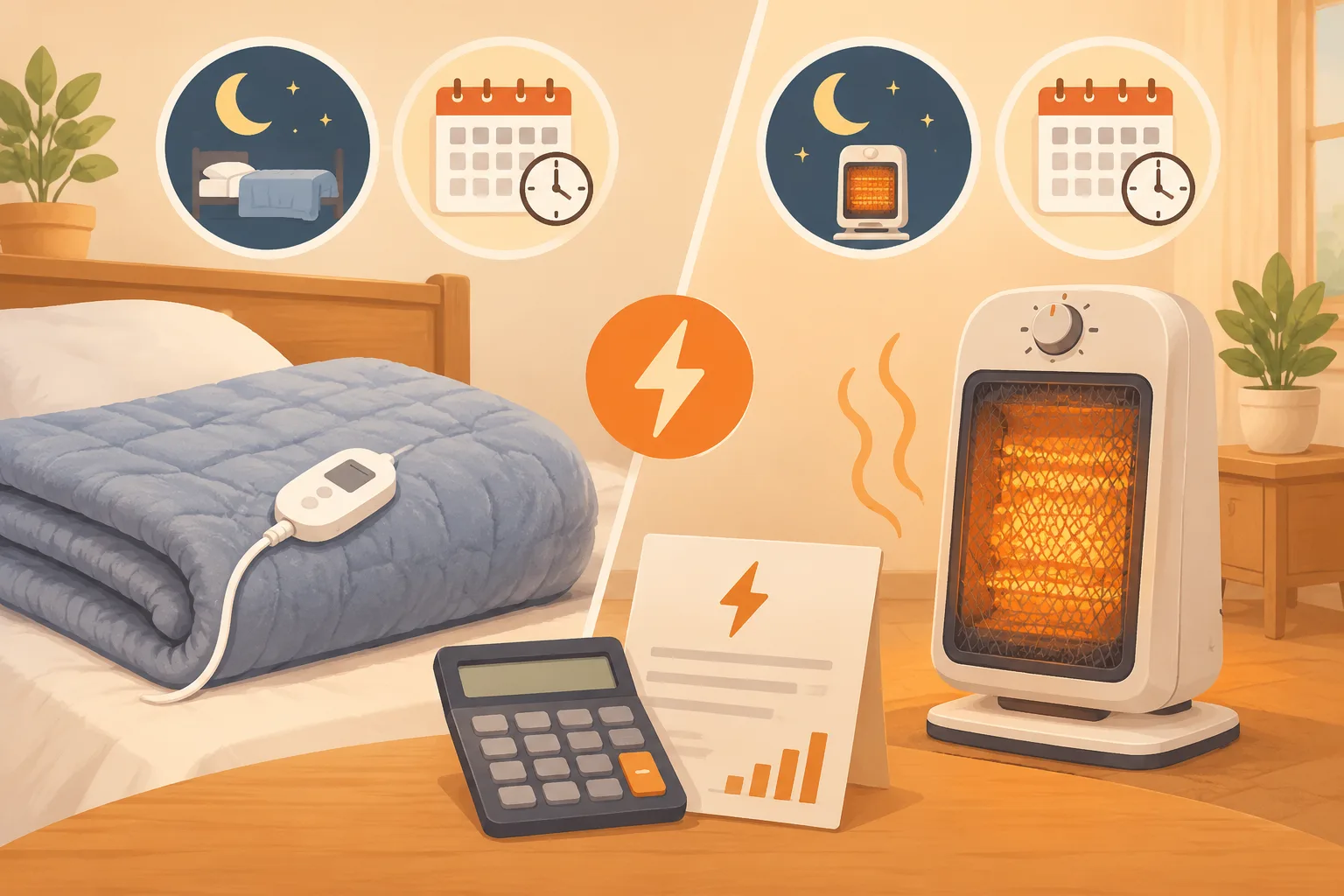
An electric blanket is much cheaper to run than a space heater. At the US average residential rate of 17.3¢ per kilowatt-hour (EIA Electric Power Monthly, Table 5.6.A, November 2025 preliminary), a queen-size blanket on for eight hours a night costs about 14¢ per night. A 1,500-watt space heater on the same eight-hour schedule costs about $2.08 per night. The gap comes from power draw: a 1,500-watt heater uses 15 times the electricity of a 100-watt queen blanket.
Appliance Energy Cost CalculatorCost per hour, day, month and year for anything you plug in.How the cost is calculated
Energy cost uses one formula: watts ÷ 1,000 × hours × rate per kWh. One kWh is 1,000 watts running for one hour. At 17.3¢/kWh, the hourly cost is:
- Queen electric blanket, 100 W: 0.100 kWh × $0.173 = 1.73¢ per hour
- Space heater, 1,500 W on high: 1.500 kWh × $0.173 = 25.95¢ per hour
Typical ratings are roughly 50 W for a single blanket and 100 W for a queen or king. Portable space heaters commonly list 750 W on low and 1,500 W on high. Check the label or manual for your model, because actual ratings vary.
Monthly comparison at 8 hours a night
The table assumes 30 nights of use at 17.3¢/kWh.
| Option | Watts | Hours per night | kWh per night | Cost per night | Cost per 30 nights |
|---|---|---|---|---|---|
| Single electric blanket | 50 | 8 | 0.40 | $0.07 | $2.08 |
| Queen electric blanket | 100 | 8 | 0.80 | $0.14 | $4.15 |
| Space heater, low | 750 | 8 | 6.00 | $1.04 | $31.14 |
| Space heater, high | 1,500 | 8 | 12.00 | $2.08 | $62.28 |
The math behind the bottom two rows:
- Space heater on high: 1.5 kW × 8 h = 12 kWh per night. 12 × $0.173 = $2.08 per night. 2.08 × 30 = $62.28 per month.
- Queen blanket: 0.1 kW × 8 h = 0.8 kWh per night. 0.8 × 30 = 24 kWh per month. 24 × $0.173 = $4.15 per month.
Even on its low setting, the heater costs about 7.5 times as much as a queen blanket, because 750 W is 7.5 times 100 W.
Shorter heater sessions narrow the gap, but not enough
Many people run a heater for only part of the night. Two hours on high is 1.5 kW × 2 h = 3 kWh, or 3 × $0.173 = $0.52 per night. Over 30 nights that is 90 kWh, or $15.57. That is still about 3.75 times the $4.15 monthly cost of a queen blanket running all night.
Thermostat cycling also lowers real use. A heater that switches off when the room reaches its set point draws less than its full rating on average. The per-hour rating is still the ceiling, though, so a heater on full power for hours will cost more than a blanket on a comparable schedule.
Rate changes the dollar amounts, not the ratio
Each rate multiplies both appliances equally, so the heater always costs about 15 times as much as the queen blanket. The dollar difference grows with a higher rate:
- Hawaii, 40.2¢/kWh (the highest rate in the EIA table): the queen blanket costs 0.8 × $0.402 = $0.32 per night, or 24 × $0.402 = $9.65 per month. The 1,500 W heater on high costs 12 × $0.402 = $4.82 per night, or $144.72 per month.
- North Dakota, 11.93¢/kWh (the lowest rate in the table): the queen blanket costs 24 × $0.1193 = $2.86 per month. The 1,500 W heater on high costs 360 × $0.1193 = $42.95 per month.
To see your own rate, use the Electric Bill Calculator or check the electricity rates by state table.
What each one actually heats
An electric blanket warms the body in contact with it. A space heater warms the air in a room. If you only need to stay warm in bed, the blanket delivers that comfort for a small fraction of the energy. If you spend hours in a room that feels cold, a heater may be the only practical option, but that comparison changes the question. Running a heater in a room you are not using wastes most of its output. For a broader view of where household electricity goes, see What Uses the Most Electricity in a House (Ranked With Numbers).
Safety notes
- Space heaters: plug the heater directly into a wall outlet. Do not use an extension cord or power strip. A 1,500 W heater on a 120-volt circuit draws 1,500 ÷ 120 = 12.5 amps. A 15-amp circuit is normally limited to 80% for continuous loads, which is 12 amps or 1,440 W. A 1,500 W heater can overload a shared circuit, so run it on a circuit with no other large loads.
- Keep space heaters at least 3 feet from bedding, curtains, and furniture. Choose a model with automatic shutoff and a tip-over switch. Turn off space heaters when you leave the room or go to sleep unless the manufacturer rates the unit for unattended use.
- Electric blankets: replace one with frayed cords or damaged controls. Do not fold, bunch, or tuck a blanket that is switched on, because heat can build up. Use an auto-shutoff model if possible.
- Electric heaters do not produce carbon monoxide. CO is a risk with fuel-burning heaters, such as gas, propane, or kerosene units.
Frequently asked questions
Is an electric blanket always cheaper than a space heater?
Per hour, yes, at the wattages in this article. A common blanket draws 50 to 100 W, while a common space heater draws 750 to 1,500 W. A blanket only warms what it touches, so the comparison holds for personal warmth. It does not show the cost of heating a whole room.
Does a thermostat-controlled space heater cost less?
It often does. A heater that cycles off at its set point draws less than its full rating on average. Your actual cost depends on how long the heater runs, so check the bill or estimate with the Appliance Energy Cost Calculator.
How do I find my heater's wattage if the label shows only amps?
Multiply volts by amps to get watts. On a 120-volt outlet, a heater rated at 12.5 amps draws 120 × 12.5 = 1,500 W. Use the same method for any appliance that lists current instead of power.
Should I lower the thermostat and use a blanket instead?
For most people in bed, a blanket with a lower home temperature costs less than heating the whole house. The exact saving depends on your heating system and how much you lower the thermostat. The Electric Bill Calculator can help you estimate your monthly total at your local rate.